


This review is spoiler-free, discussing the series’ premise, characters and themes without revealing major plot developments.
Before it became an anime, The Ogre’s Bride began as a novel series written by Kureha and published in 2020. A manga adaptation illustrated by Jun Togashi followed in 2021. The 2026 anime is directed by Kazuhito Omiya and animated by Colored Pencil Animation Japan. It brings the story’s mix of Japanese folklore, supernatural romance and Cinderella-inspired family drama to the screen.
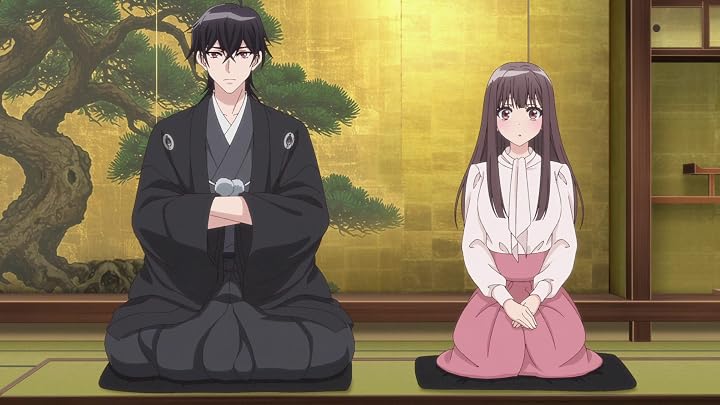
In a world where humans live alongside ayakashi, powerful supernatural beings can recognize their destined brides. Yuzu, neglected by her family in favor of her younger sister, Karin, has little reason to believe she is destined for anything good. That changes when Reiya, an ogre, chooses her. The series’ most compelling question isn’t simply whether the two will fall in love; it’s whether Yuzu can begin to trust the care she has been denied.

Yuzu’s family has built its life around Karin. Their parents praise Karin, invest in her future and expect her to secure the family’s comfort through marriage. Yuzu, meanwhile, is left to serve the household and absorb the blame. The imbalance is not subtle, and the series doesn’t ask viewers to mistake neglect for ordinary sibling rivalry. It shows how years of being dismissed can reshape someone’s sense of what she deserves.
That history informs Yuzu’s quietness. She doesn’t always respond to kindness with confidence, and her hesitation can make her seem like a passive heroine at first. I found it more convincing to read those moments as caution. Yuzu has learned that attention can bring danger, while the people who should have cared for her failed to notice her at all. Reiya’s promises may be sincere, but accepting them is a different challenge from hearing them.
The show’s central romance works best when it gives Yuzu room to react at her own pace. Reiya offers a home, protection and a kind of devotion she has never experienced. The contrast is satisfying, though the destined-bride premise can make the relationship feel predetermined. Yuzu’s gradual adjustment is what gives the romance some emotional texture: safety is not simply handed to her when she meets the right person.
Karin provides the story’s sharpest conflict. Her parents helped cultivate her sense of entitlement, but the series still holds her responsible for how she treats Yuzu. When the family realizes Yuzu has been chosen by an ogre — a more powerful match than Karin’s kitsune fiancé, Yota — their sudden interest in her makes clear that their affection has always been conditional. Karin’s resentment then grows from a lifetime of being told she deserves everything, rather than from any real effort to understand her sister.
The fairy-tale structure is easy to recognize, but the series uses it to highlight the sisters’ different upbringings. Yuzu has been denied care; Karin has been taught to expect it. Their paths are not simply a contest between a good girl and a bad one. The parents’ choices help explain how the sisters became so different, even if that context doesn’t erase the harm Karin causes. At times, the story pushes her consequences toward melodrama, but its directness fits a tale in which Yuzu needs to see that the people who hurt her no longer control her future.

Yota, Karin’s fiancé, is treated with more sympathy. The supernatural bride system appears to place real pressure on the men caught in it, and Yota’s age makes his limited ability to resist Karin easier to understand. Still, the series could give him more room to be a character in his own right instead of mostly a way to reveal the system’s rules.
The production is uneven. Some scenes land with expressive artwork and effective animation, while others look serviceable rather than memorable. The smaller ogres bring a welcome dose of charm, and the voice cast helps sell the emotional stakes. Saori Hayami gives Yuzu a soft, guarded delivery that suits someone accustomed to making herself small; viewers may need to pay close attention to catch the hurt beneath her words. The music is another reliable strength.
I also found the series’ use of “demons” for ayakashi imprecise. The terms carry different associations, and preserving the Japanese word could have kept more of the setting’s folklore intact.

The Ogre’s Bride is most affecting when it treats recovery as a process rather than a reward. Yuzu may have a long way to go before she can fully trust the life she has found, but the series gives her a meaningful first step: a chance to imagine that care can be freely given. Her story may begin like a familiar Cinderella romance, yet its heart is in the difficult journey from surviving neglect to believing she deserves better.
For viewers drawn to supernatural romances with a fairy-tale frame, The Ogre’s Bride offers a tender, if uneven, watch. Its strongest moments come from the space it gives Yuzu to slowly recognize that she is worthy of love. The ogre may open the door to her new life, but the series’ real payoff is watching her begin to believe she can walk through it.

The Ogre’s Bride is currently streaming on Crunchyroll.
————
AnimeTV チェーン bringing you the latest anime news direct from Japan ~ anytime! — Your new source of information!